LISTEN ON APPLE PODCASTS | LISTEN ON SPOTIFY | LISTEN ON AMAZON MUSIC
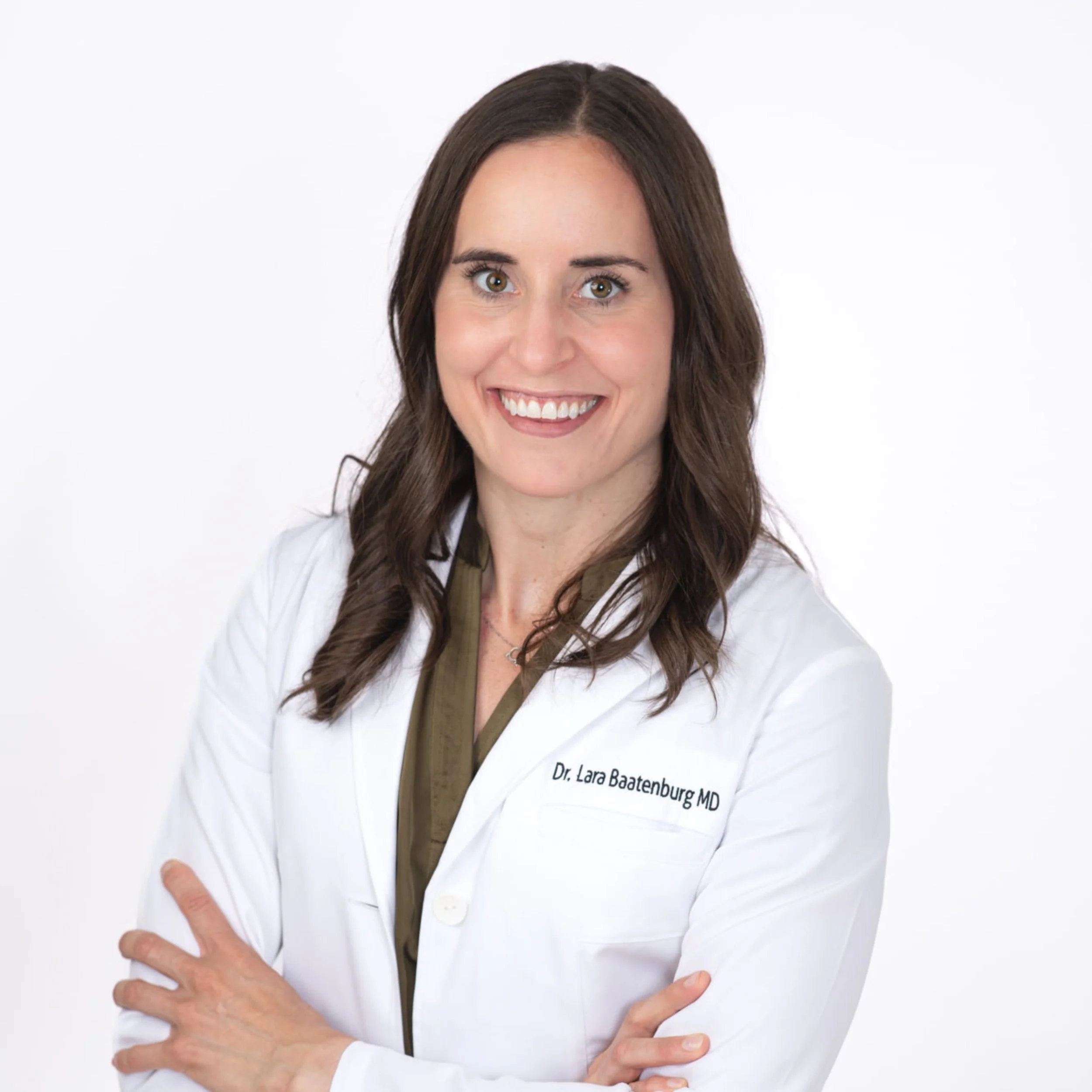
The story starts at 5:30 in the morning, with Dr. Lara Baatenburg between sets of strict press and deadlifts. A patient texts: her eye is red, itchy, and bothering her badly. Can she come in today? Lara offers 9 a.m.
By 10:10 the problem was found, treated, and handled. In this episode, David asks her to set that morning beside her years in a traditional insurance practice, and the comparison says more than any complaint about the system could.
Three thousand patients, and where the time goes
Dr. Lara’s old panel was over 3,000 patients. She had a closed panel, but the health system let any existing patient transfer to her, and she couldn’t say no. At Concierge Medicine of West Michigan she won’t carry more than 300, a tenth of that.
A typical day in the old practice meant about 20 patients in person, with visits running anywhere from 7 to 15 minutes. That was only part of the work. The other 3,000 patients were also sending portal messages, asking about labs, and requesting refills, at least 30 a day. Some were exactly what the portal is for: a medication started two days ago, and now a side effect. Many were requests for care without a visit: tell me what to do about this rash, or just send in an antibiotic.
Her answer was usually to schedule an appointment. A two-sentence message and a photo rarely tell you enough, because the useful questions are about how long it’s been there and what changed. Nurses made up much of the difference. The good ones protected the physicians and got patients on the schedule, and Lara is quick to give them credit. But a new appointment could be weeks away, and for anything more urgent the advice was often urgent care.
The eye that didn’t look right
When the patient arrived at 9, her eye was swollen, red, and tearing constantly. Dr. Lara had hoped for something simple, like mild conjunctivitis, and a prescription for drops. It didn’t feel right. She calls that gut feeling the part of medicine that can’t be taught from a textbook. You can know the physiology cold, but years of practice are what tell you this one won’t just clear up.
She asked her questions, hoping for reassuring answers, and then decided the patient needed her eye doctor that day. She asked the front desk to call the eye doctor’s office, told them what to say, and went back to the patient. The patient had another health question. In her old practice, Lara says, that appointment would already have been over. Here they worked through the second topic, and by the time they finished there was a knock at the door: an appointment in 20 minutes.
The eye doctor found a serious infection that needed antibiotic drops that day. The pharmacy was out, and the eye doctor’s office was hard to reach. The patient texted Dr. Lara, who got the prescription moved to another pharmacy. From first text to resolution, it took about four and a half hours.
The same text in the old system might have sat in a portal inbox until 4 p.m. Or it might have meant a long ER wait, which is the other thing people weigh. Delays like that are how a problem that could be fixed in a morning turns into a bigger one.
A patient who needed an EKG, not an ER visit
The same week, a newer patient with a history of atrial fibrillation texted in the middle of the day. His heart felt strange, and he asked if he could come in for an EKG. Dr. Lara said to come at three. They did the EKG, made a plan, and he left telling her this was exactly why he’d joined the practice.
In a traditional office, a call about chest-related symptoms goes to a nurse, who is supposed to send the patient to the ER unless a physician can be reached. Finding that physician between patients is the hard part.
The annual physical, from behind the curtain
Most patients think the annual physical is the time to bring up everything that’s been bothering them. Dr. Lara explains that insurers and health systems see it differently. A physical is preventive screening: colonoscopy, mammogram, Pap smear, prostate screening, labs, and a medication check. An acute or chronic concern is billed as a different kind of visit.
That mismatch is why patients feel unheard. Some are told to schedule a separate appointment for their problems. Others get the conversation and then a bill they didn’t expect. She says some local health systems have told physicians not to address other concerns during a physical at all. Lara never liked that rule and talked to her patients anyway.
At CMWM, the physical still covers the screening items, then moves on to everything the patient is dealing with, followed by a real look at nutrition, exercise, sleep, and stress. They talk about macros and fiber instead of just “eat more fruits and vegetables,” and about how to weight train effectively. InBody scans show body composition beyond weight and BMI, which Lara says can be eye-opening. In her old practice, “eat more fruits and vegetables” was often all she had time to say.
The red result
In Lara’s old system, lab and imaging results went to the patient the moment they were released. A patient could be reading a result on their phone hours before the physician, who was in clinic with 20 patients, got to it. By the time she did, there would already be a worried message waiting.
At CMWM, results don’t go out until she releases them, and she responds quickly. She also spends time on what the colors mean. Red only means a result is outside the reference range. For some tests that matters a great deal, but for many it means nothing. A complete blood count is a good example. There are so many values on it that she’s surprised when everything is in range, and a single value slightly out is usually nothing. A pattern is what points to a diagnosis. Looking back, she guesses that about 20 percent of her old portal messages were patients worried about a result like this.
When the news is hard
Some results are serious in any system. Dr. Lara has had an unexpected finding on a chest scan come up in both practices, and in both she says you drop everything. In the old office, a radiology tech who couldn’t say anything to the patient called Lara over from across the hall. Lara had to speak to the patient right there while her own waiting room backed up. At CMWM, a patient saw her result first through the hospital’s portal and called the office. Lara was on her honeymoon, so her sister, Dr. Jana, picked up, talked her through a plan, and arranged the follow-up that day. The difference was that Jana had the time to do it without running behind on everyone else.
David’s summary is that the big problem isn’t the rare emergency. It’s the way small problems pile up when nobody has room to breathe.
What she misses, and what she’d never give back
She misses her staff. A big office has a lot of good people who look out for each other, and she says there’s something special about that. But she rarely spoke to the other providers there, because everyone was too busy, and she once worked beside a physician for a year and a half and talked to him about five times.
What she enjoys most now is how well she knows her patients, which, she says, happens faster here than it would in a traditional practice. Patients bring her research on their symptoms, and she has time to read the literature and look for new ways to diagnose or manage a problem. In her old practice, the answer was often “your labs are fine.” Now patients sometimes push her toward the door at the end of a visit, which never happened before.
The doctors in the old system aren’t the problem. Dr. Lara’s training didn’t change when she left, and neither did her knowledge. What changed is how much time she has, and she says she’s thankful for it.
What would you do with a doctor who had the time to follow up? Schedule a complimentary Meet & Greet with Dr. Lara or Dr. Jana Baatenburg and see what a 300-patient practice feels like from the other side of the exam table.
Vitals & Values is the podcast of Concierge Medicine of West Michigan, hosted by Dr. David Roden and Dr. Lara Baatenburg. New episodes available wherever you listen.