DO YOU REALLY NEED THE ER? | The $350 vs. $2,000+ Healthcare Problem
LISTEN ON APPLE PODCASTS | LISTEN ON SPOTIFY | LISTEN ON AMAZON MUSIC
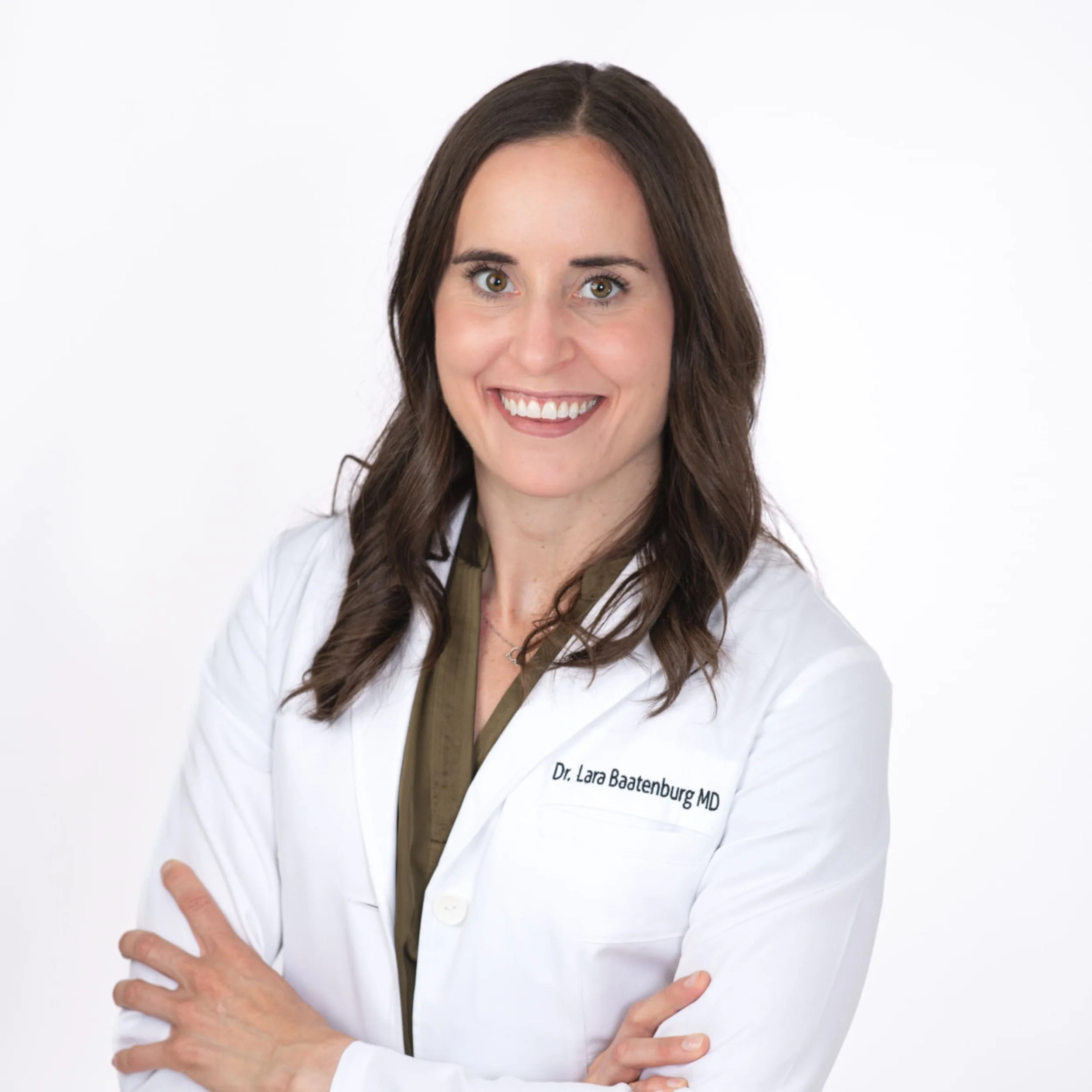
Same country, same insurance, wildly different bills for what amounts to the same problem. David lived that gap firsthand this summer — an object lodged in his eye, a $2,000 ER visit he was bracing to pay, and a $300 alternative that solved the problem in 20 minutes. In this episode, he and Dr. Lara Baatenburg sit down with Dr. Todd Chassee, medical director and emergency physician at Right Care Clinic, to unpack the model behind that gap and why it's still such a rare thing to find.
Where the idea came from
Dr. Chassee has practiced emergency medicine in West Michigan for 20 years as part of Emergency Care Specialists — a physician-owned group of nearly 200 ER doctors operating since 1984, entirely without private equity involvement. Right Care Clinic grew out of a simple, uncomfortable observation from inside that world: almost nobody enjoys coming to the ER. It's expensive, inconvenient, and the physical environment itself works against healing. The group had the clinical skill set to treat almost anything, anywhere. What they didn't have was a setting that made sense for patients whose problem didn't actually require a full emergency department.
Early versions of the concept — including an attempt to bring emergency medicine directly into patients' homes — sat on the shelf for years due to logistical and financial obstacles. Right Care Clinic, which opened in July 2024, is the model that finally worked.
David's actual experience
The story itself is almost comically mundane and exactly the point. David woke up with something lodged behind his eyelid, spent hours trying to flush it out himself, and by morning was in real distress. An ER visit felt inevitable and expensive. Instead, Dr. Lara pointed him to Right Care Clinic, which happened to be opening within the hour. He was the first patient in, seen within two minutes, had the foreign body removed and a minor corneal scratch treated, and was out the door in 20 minutes total — payment included. The final bill: roughly $300, against an ER estimate north of $2,000 for the same visit.
Dr. Chassee's response captures something real about 20 years in emergency medicine: he can deliver the exact same clinical care in the ER and have patients leave frustrated — not because of anything he did, but because of the wait, the environment, the hallway beds. Hearing a story like David's, where the care itself is unremarkable but the experience around it actually works, is part of what's renewed his enthusiasm for the field.
Where Right Care sits between urgent care and the ER
The clinic occupies a deliberately specific niche — what Dr. Chassee calls "ER light" or "super urgent care." Standard urgent care in West Michigan is genuinely basic: X-ray, a couple of point-of-care labs, an advanced practice provider, an EKG. Walk into urgent care with chest pain, and even with an EKG available, they typically can't rule out a heart attack — so you get sent to the ER regardless.
Right Care closes that gap. On-site CT imaging, expanded lab capability including cardiac and clotting workups, IV fluids and IV medications, and an actual emergency physician on staff — not to diminish advanced practice providers, whom the group also employs extensively, but a different level of training and evaluation for genuinely acute presentations. Abdominal pain that might indicate appendicitis, migraines unresponsive to oral medication, post-surgical complications — these are exactly the kinds of cases the clinic is built to handle without a full ER visit.
What still belongs at a real emergency department: strokes, uncontrolled bleeding, and other conditions requiring immediate, comprehensive intervention. Notably, even chest pain — the classic "call 911" scenario — often gets evaluated at Right Care first, partly because the data shows patients frequently don't follow 911 advice regardless of what they're told, and the clinic would rather be a genuine option than have patients bypass care altogether.
Why physician ownership changes the calculation
Right Care Clinic has zero private equity involvement — every physician in the group is an equal owner. Dr. Chassee is direct about what that structural choice means in practice: the people making decisions about how the business runs are the same people directly treating patients. That alignment shaped the entire launch, including the fact that startup capital came entirely from the physician-owners themselves, without outside investment — a genuine constraint that shaped how conservatively the clinic scaled at first.
This matters because the alternative model — freestanding emergency departments that exist in other states like Texas — can look nearly identical on the surface (lab, physician, CT scanner) while billing at full ER facility rates. Right Care's structure as a specialist physician office, rather than a facility billing model, is precisely what keeps a $2,000 problem down to $300.
The part insurance doesn't make easy
The financial reality behind the clinic's low patient costs is more complicated than it looks from the patient side. Insurance reimbursement for the value being created — treating a $2,000 ER-level problem for a few hundred dollars — hasn't fully caught up to the model yet. And on the patient responsibility side, the clinic currently collects roughly one-third of what patients owe after insurance processes claims. The rest goes to collections. It's not a sustainable long-term dynamic, and it's one of the genuine open challenges facing the model as it tries to prove financial viability at scale.
None of that is a criticism of insurance companies specifically — Dr. Chassee is careful to note that reimbursement structures are complicated for everyone involved. It is, however, a real structural friction that a model built entirely around patient value still has to solve.
What two years actually taught them
The clinic opened without fully appreciating two things: how many patients would find them purely through Google search and online reviews, and how much harder marketing a genuinely new concept would be. Explaining an unfamiliar care model — one that doesn't map cleanly onto "urgent care" or "ER" — turned out to be a bigger lift than expected, both with the public and with referring physician practices.
Partnerships with surgical and urology specialists have become a meaningful and unexpected source of referrals — post-surgical patients needing IV fluids or infection workups, urology patients needing imaging without an ER-level visit. These are exactly the populations the model was built to serve, showing up through channels the clinic hadn't originally anticipated as primary.
Physician burnout, and why the schedule is the real problem
The conversation turns briefly to burnout in emergency medicine generally — a genuine, structural issue tied less to the clinical work itself and more to the disruption of sleep cycles, missed weekends, and the accumulated cost of shift work over a career. Dr. Chassee's group builds in a mandatory month off every 19 months specifically to help reset that cycle. It's a partial mitigation, not a full solution — the underlying tension between emergency medicine's schedule demands and a physician's life outside of work doesn't fully resolve, even with structural accommodations in place.
What's next
Dr. Chassee's near-term goals: expanding hours, including weekend availability, and reaching genuine financial sustainability — the prerequisite for eventually replicating the model elsewhere in Michigan. The clinic works deliberately across all three West Michigan health systems and independent physician groups rather than aligning with just one, a positioning Dr. Chassee sees as essential to the model's long-term value: a genuinely agnostic access point, not another silo in an already fragmented system.
Vitals & Values is the podcast of Concierge Medicine of West Michigan, hosted by Dr. David Roden and Dr. Lara Baatenburg. New episodes available wherever you listen.
Tired of choosing between an inflated ER bill and a doctor who doesn't have time to actually look at you? Schedule a complimentary Meet & Greet with Dr. Lara or Dr. Jana Baatenburg and find out what it's like to have a physician who has the time — before you're standing in a waiting room wondering if it's worth it.