Are Your Hormones Really Out of Balance? — Cortisol, Testosterone & Menopause Myths
LISTEN ON APPLE PODCASTS | LISTEN ON SPOTIFY | LISTEN ON AMAZON MUSIC
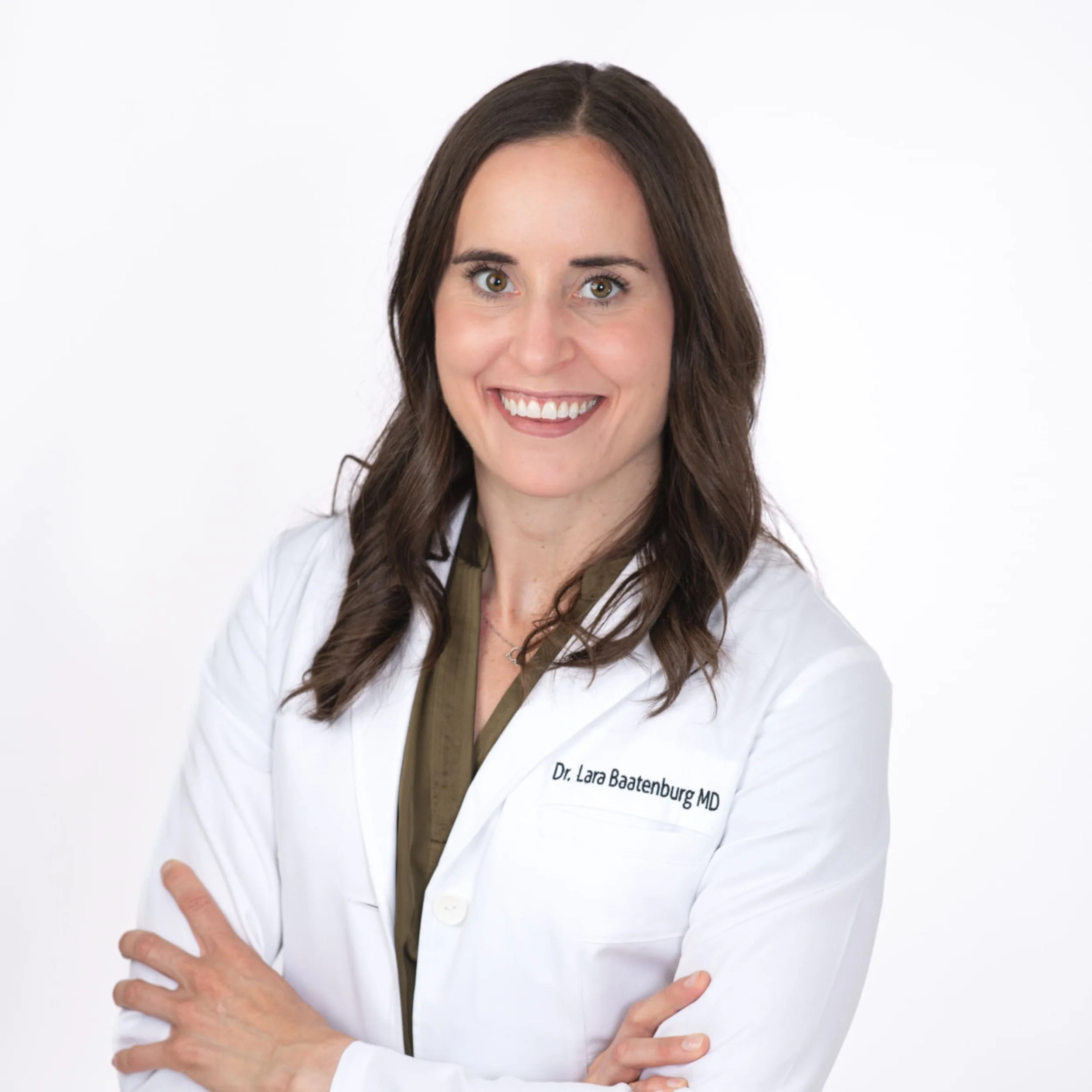
The same handful of symptoms — tired, foggy, can't lose weight, sleep is off — get blamed on a different hormone depending on which corner of the internet you happen to land on. This month it's cortisol. Last year it was insulin. Before that it was something else entirely. In this episode, David and Dr. Lara Baatenburg walk through cortisol, testosterone, perimenopause, and thyroid one at a time — what each one actually does, when testing genuinely helps, and why the online version of hormone health rarely matches what shows up in an actual exam room.
Cortisol: the diagnosis almost nobody actually has
Cortisol is real, and it does what people generally think it does — the body's principal stress hormone, following a daily rhythm that helps regulate wakefulness. Where the story goes wrong is the leap from "cortisol responds to stress" to "my vague symptoms mean my cortisol is pathologically high."
The actual condition that causes cortisol excess is Cushing syndrome, and it's genuinely rare — 2 to 8 cases per million people per year. Dr. Lara has never treated a case. David recalls spotting a milder, undiagnosed case in a family member at a wedding years ago, based on the distinctive rounded facial appearance that's a hallmark symptom — later confirmed by a pituitary tumor diagnosis. That's what real cortisol excess looks like. It's a distinct, identifiable clinical picture, not a feeling of being tired and inflamed.
What's actually happening for most people worried about "high cortisol": stress genuinely does activate the body's cortisol response, and stress often drives comfort eating, which is what's actually affecting weight — not the cortisol itself. A statistically elevated-but-still-normal cortisol level isn't the same thing as a clinically significant one, and Dr. Lara has never had a patient's cortisol test come back abnormal when checked for these vague, general symptoms.
Testosterone: real, common enough, but not a magic fix
True hypogonadism — a body genuinely not producing enough testosterone — affects an estimated 2 to 8 percent of men, more common than Cushing syndrome but still far from universal. David has personal experience on both sides of this conversation: morbidly obese for years with low testosterone that normalized after losing 200 pounds of body fat, and more recently starting TRT after watching his levels decline over several years despite already excellent sleep, nutrition, and training habits.
His experience is a useful data point precisely because it's nuanced rather than dramatic. TRT didn't turn him into a different person — he still eats plenty and hasn't dropped significant body fat from it. What changed: a specific anxious feeling he used to get around 10pm disappeared, his energy and focus improved, and his strength ticked up modestly. Not the mythical transformation some men expect.
The single biggest reversible cause of low testosterone is abdominal fat and obesity — excess visceral fat elevates estrogen, which suppresses testosterone, creating a self-reinforcing cycle. This is why Dr. Lara's approach isn't to treat the number in isolation. A man with a low-normal testosterone level might feel completely fine; another with a level most would consider normal might feel awful. She's had an elderly patient with genuinely severe hypogonadism — a testosterone level around 50 — who reported no symptoms at all and declined any treatment. The lab value alone never tells the whole story.
Perimenopause: real, but often mistimed
A pattern Dr. Lara has noticed increasingly in her practice: women in their mid-to-late 30s convinced they're in perimenopause, largely based on social media content. The average age of menopause is around 51, with perimenopausal symptoms typically beginning 5 to 8 years earlier — meaning the early-to-mid 40s is the common window, not the 30s.
Primary ovarian insufficiency, when menstrual changes consistent with menopause begin before age 40, is a genuine and distinct diagnosis requiring its own specific evaluation. But for most women in their 30s experiencing fatigue, brain fog, low energy, or sleep disruption, perimenopause is one possible explanation among many — family stress, work demands, and a dozen other causes can produce the identical symptom list. Dr. Lara isn't discouraging the conversation with a physician. She's cautioning against jumping straight to a conclusion before ruling out other explanations.
Hormone testing during perimenopause: why the timing matters
This is where Dr. Lara draws a clear, evidence-based line — one she's aware puts her at odds with some functional medicine practitioners, having shared a menopause panel stage with one who holds the opposite view. During perimenopause, hormone levels fluctuate erratically rather than following the steady pattern of the preceding decades. A single blood draw captures one moment in an unpredictable cycle. It can come back completely normal in someone with clear symptoms, or abnormal in someone with none — either way, it doesn't tell you much.
Her analogy: nobody sends an 11-year-old for hormone testing to confirm she's starting puberty just because she got her first period. The age and the symptom pattern together are usually sufficient. The same logic applies at the other end of reproductive life. If a woman is the right age and her symptoms are consistent with perimenopause, a hormone panel often doesn't add clinically useful information — though Dr. Lara does order them for patients who want that data point after understanding its real limitations, and often the conversation itself is what patients actually needed.
There's an important exception where hormone testing genuinely matters: confirming absorption once treatment has started. Dr. Jana had a patient on compounded subcutaneous estrogen from another provider who still felt unwell. Checking her estrogen level revealed it was non-detectable — she was taking a hormone that wasn't actually reaching measurable levels in her blood. Switching to an FDA-approved patch resolved both the lab finding and her symptoms. That's a hormone test used correctly: to verify a treatment is working, not to diagnose the underlying condition in the first place.
A related myth worth retiring: FDA-approved, doctor-prescribed bioidentical hormones exist and are commonly used in standard medical practice. Patients don't need to seek out compounded formulations through functional medicine specifically to access bioidentical hormone therapy.
Thyroid: the most common ask, and sometimes the right one
Thyroid testing tops Dr. Lara's list of most-requested hormone checks, and for good reason on two fronts: hypothyroidism is a genuinely common condition, and it's straightforward to treat once identified. In the U.S., roughly 4.6% of the population over age 12 has some form of hypothyroidism — higher than either Cushing syndrome or classic hypogonadism, though still far from the assumed universal explanation for weight struggles.
Hypothyroidism can cause weight gain, so checking it when weight changes feel unusual or unexplained is entirely reasonable. What's less reasonable is the reflexive assumption that thyroid dysfunction — rather than diet, sleep, alcohol, or activity level — must be the singular explanation for weight that isn't moving the way someone wants.
The pattern underneath all four
Across cortisol, testosterone, perimenopause, and thyroid, the same handful of vague symptoms keep showing up: fatigue, brain fog, weight changes, low energy, disrupted sleep. Depending on which online source someone encounters first, any one of these hormones gets cast as the singular explanation — and, not coincidentally, whoever's making that claim usually has something to sell as the fix.
None of this means these conditions aren't real or worth investigating. It means human physiology is genuinely complex, and reducing a cluster of nonspecific symptoms to one hormone — cortisol this year, insulin a few years ago, something else next — is a marketing strategy more than a diagnostic one. Dr. Lara ran a quick, informal check across Instagram while prepping for this episode: search any of these hormone terms and the top results reliably lead toward a masterclass, a consultation, or a $1,790 sixty-eight-panel hormone test from an out-of-state clinic. The pattern holds regardless of which hormone gets searched.
The reliable fixes, more often than not, are the same ones that show up in nearly every episode of this podcast: sleep, stress management, nutrition, and movement. That's not a dismissal of legitimate hormonal conditions — it's a reminder that they're the exception being investigated, not the default assumption to start from.
Vitals & Values is the podcast of Concierge Medicine of West Michigan, hosted by Dr. David Roden and Dr. Lara Baatenburg. New episodes available wherever you listen.
Tired of guessing which hormone is "the problem" based on an Instagram reel? Schedule a complimentary Meet & Greet with Dr. Lara or Dr. Jana Baatenburg and get an actual clinical read on what's going on with your body.